
Tierinii Jackson Naftaly
The Voice.
The Road.
Memphis.
Memphis gave me the roots. The road gave me the range. The music is where I get to decide what to do with both.
Memphis. The road. A legacy. The world.
Grammy
2x Nominated — Best Contemporary Blues Album
Blues Foundation
Blues Music Award Winner
Stax Records History
Part of the first Memphis-based act signed to the reformed Stax imprint since the 1970s
Sinners
Featured on the Grammy-winning soundtrack
Memphis
Where it started. And why it stuck.
Tierinii Jackson Naftaly grew up in Memphis, Tennessee — one of the few cities on earth where music isn't a career choice so much as a condition of living there. The blues, the soul, the gospel, the grit: all of it was in the air, in the churches, in the corner clubs, in the stories passed down by people who had worked at Stax Records, who had watched Otis Redding play, who remembered what it felt like when a city produced some of the most honest music America had ever made.
For Tierinii, the foundation was built in church. Singing in tight, disciplined congregations taught her things a music school never could: how to hold a note with restraint, how to build a room to the edge of breaking before giving it release, how to make a lyric feel like testimony rather than performance. That training planted something deep. It also created a tension that would define everything that came after.
She left. Not away from belief, but toward her own version of it. She walked away from home, away from the church, out into the open road that Memphis musicians have always understood as the other place where the spirit goes when the walls get too small. She went looking for her own path and she found it in the music itself. What you hear in her voice is the evidence of that journey. It was earned the hard way, in private, long before anyone was watching.
Southern Avenue
Named for the street. Signed to the legend.
The band's name is not a coincidence. Southern Avenue runs directly past the original site of Stax Records — the building where Isaac Hayes, Carla Thomas, and Mavis Staples made music that changed what American soul could be. When Tierinii and guitarist Ori Naftaly formed Southern Avenue, they named it after that street on purpose. They knew where they were standing in history and they took it seriously.
Less than a year after coming together, Southern Avenue made history by becoming the first Memphis-based band signed to the reformed Stax Records imprint since the 1970s. That wasn't a marketing story. It was a cultural weight. The label had been dormant for decades. Choosing Southern Avenue to carry the name forward was a statement about what Memphis blues and soul could still be when the artists were built from the tradition rather than borrowing from it.
Tierinii's sisters T.K. and Ava Jackson were part of the original Southern Avenue lineup alongside Ori Naftaly, whose guitar work and co-writing shaped the band's sound from the beginning. The self-titled debut in 2017 and Keep On in 2019 were both released under the Stax banner — and Keep On earned the band their first Grammy nomination for Best Contemporary Blues Album. A second nomination followed for Family, released on Alligator Records in 2025, which stands as the most personal and fully realized work of the catalog.
The road built the rest. Southern Avenue became a touring proposition that could not be ignored: Memphis stages, international theaters, festival fields, and rooms that had to be won in real time, night after night, before the credentials arrived to confirm what the audiences already knew.
"Southern Avenue is the vehicle for Tierinii's original songwriting. The blues structure, the Memphis soul, the rock and roll momentum — all of it built from the inside out."southernavenuemusic.com
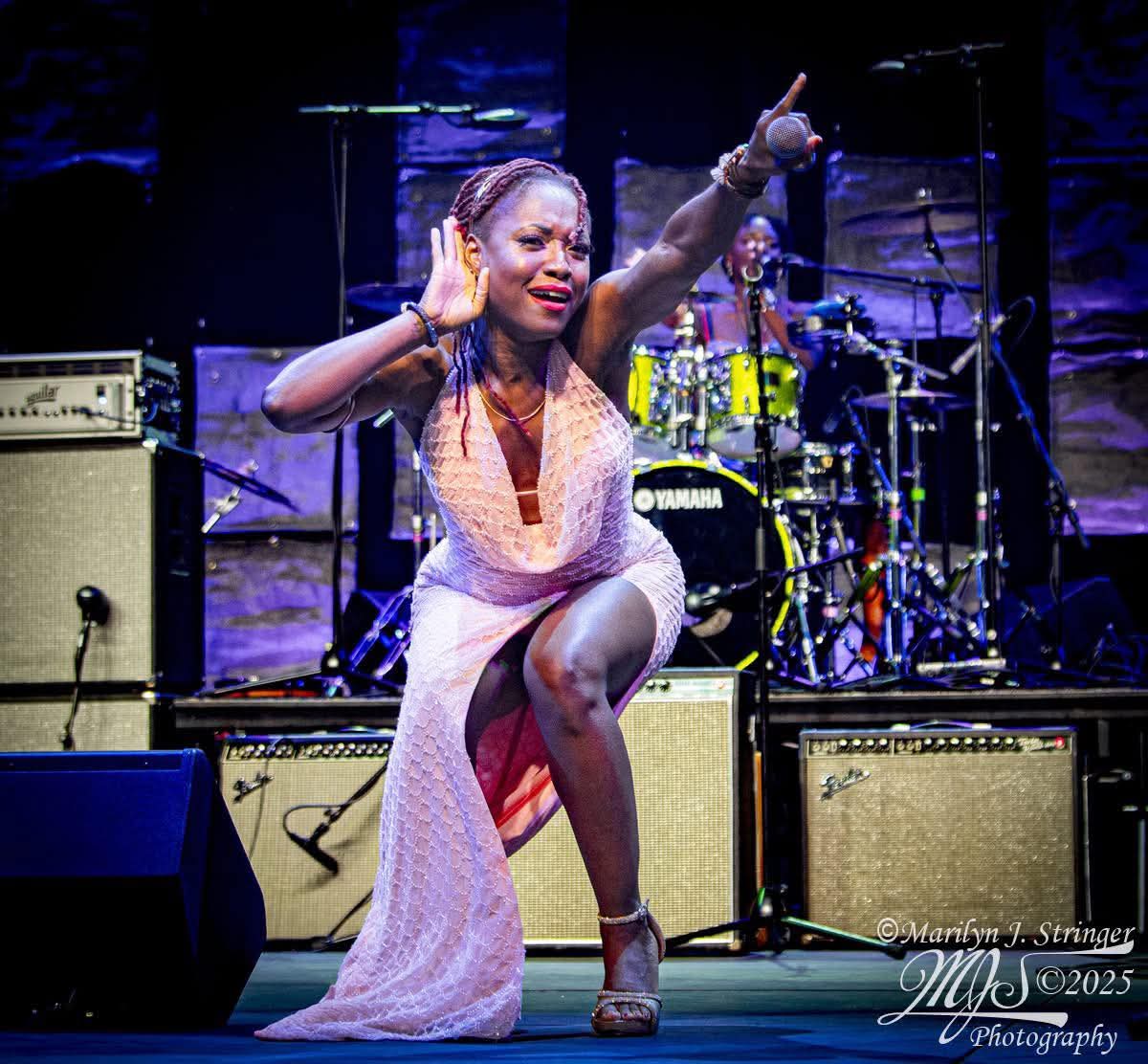
The Road
The stages that proved it.
The story of Tierinii's career is a story of stages earned, not given. Farm Aid placed her alongside Willie Nelson, Bob Dylan, Sheryl Crow, and John Mellencamp — the defining gathering of American roots music, where the audience knows the tradition and watches to see if you do too. Farm Aid is not a showcase. It is a test. She passed it in front of tens of thousands of people.
Touring with the Tedeschi Trucks Band — one of the most serious blues and Americana acts working today — meant playing to rooms full of listeners who came specifically because they care about the music as a living thing. Supporting Jason Mraz brought her to an entirely different audience and deepened into something creative: Tierinii co-wrote with Mraz, a collaboration that says more about her as a songwriter than any single genre label can. She can meet a writer from a completely different world and make something real. That range is not common.
Bonnaroo, Austin City Limits, the New Orleans Jazz and Heritage Festival, the Chicago Blues Festival, AmericanaFest, the Legendary Rhythm and Blues Cruise — each stage built the case independently. By the time the film placements and major collaborations arrived, the road had already done the work. Audiences in the United States, Europe, Canada, and Australia had already found her. The credentials confirmed what the stages already proved.
Sinners
The film didn't find her. It recognized her.
Sinners is a film about people caught between the sacred and the dangerous. Between what the church built in you and what your own soul keeps asking for. Between the life you were handed and the life the music is pulling you toward. It is about what happens when the spirit you were given is too large for the walls meant to contain it.
That is not a story Tierinii Jackson Naftaly learned from a script. It is her actual biography.
She grew up inside the strict spiritual world of Memphis church culture — the same devotion, the same discipline, the same deep communal roots that form the moral architecture of the film. And then she walked away from it. Not because she stopped believing in something sacred, but because she had to go find it on her own terms. She left home. She left the church. She went out into the unknown and found her own spiritual path through the music itself. What she carries in her voice is not a performance of that journey. It is the journey.
Lay that against what the film is about, and the casting stops looking like a decision. It looks like recognition.
The musical credentials run just as deep. Southern Avenue was named after the street that runs directly past the original Stax Records building — the label whose sound forms the spiritual and sonic foundation of the film's entire world. Tierinii and that band were signed to the reformed Stax imprint, becoming the first Memphis act to carry that name since the 1970s. She didn't borrow from that tradition. She was already inside it.
"Can't Win for Losin'" was written and performed with Cedric Burnside — the grandson of R.L. Burnside, and a living carrier of the Mississippi Hill Country blues lineage that runs directly through the film's musical DNA. Their collaboration is not a soundtrack pairing. It is two artists from the same bloodline of the music finding each other at the right moment. The track was produced by Boo Mitchell at Royal Studios in Memphis — the room where Al Green, Ann Peebles, and generations of Memphis soul were recorded. The musical direction was by Oscar-winning composer Ludwig Göransson.
The soundtrack won the Grammy Award for Best Compilation Soundtrack. The tracks were nominated because they were already real. Tierinii's voice fit the film's world because she had already paid the price of admission — in the church she grew up in, on the road she built, and in the personal reckoning that shaped everything in between.
"The film's central question is what she already lived. What do you do with the spirit you were given when the walls meant to hold it can no longer contain it?"

Morgan Freeman's Symphonic Blues Experience
The circle completes.
On Morgan Freeman's Symphonic Blues Experience, Tierinii's voice stands alongside Taj Mahal, Keb' Mo', and Shemekia Copeland on a project that places the blues inside its full historical and orchestral scale. Her contribution is lead vocals on "I'll Take You There" — the Staples Singers' anthem, carried for decades by Mavis Staples.
That song choice is not incidental. Mavis Staples spent her entire life at the exact intersection Tierinii has navigated: gospel and secular music, devotion and freedom, the church she was raised in and the open road she chose instead. "I'll Take You There" is a song about crossing from one world into another and finding something sacred on the other side. Of all the songs in the blues and gospel canon that could have been chosen, this is the one that maps directly onto what Tierinii's life has actually been.
The track was recorded at Royal Studios in Memphis and Abbey Road in London. Behind her is the Stax Music Academy Choir — young musicians trained on the Soulsville campus, the same ground where the original Stax Records stood. These are the students of the tradition Tierinii's own career was built on. Here she is, sharing a global stage with them, passing to the next generation what Memphis gave to her.
That is not symmetry invented for a press release. It is what happens when a career is built with genuine roots in a place and a tradition. The lineage finds its way back around.
Right Now
Visible. Grounded. Still going.
Tierinii Jackson Naftaly stands at a strong point in her career: Grammy-recognized, road-hardened, critically respected, and still in motion. The records, the stages, the collaborators, and the film work all point toward the same truth. The voice was never small. More of the world is simply hearing it now.
She is not being introduced from scratch. She is being seen more clearly. What listeners respond to is the combination: emotional depth, physical presence, musical command, and a Memphis-born sound that still feels fully alive in the present tense. The power comes from restraint as much as it comes from volume. She knows when to pull back and when to let it go — and when she lets it go, you feel it in your chest.
The blues has always had powerhouse vocalists. Rarely has one arrived carrying this much evidence of what Memphis can produce.
Hear what the story sounds like.
Start with Sinners. Stay for Family. Find it everywhere.